A Seasonal Drawer Reset Without Buying Organisers
A seasonal drawer reset without buying organisers helps you compare quick sorting with a fuller rotation, using spare containers and leaving useful room.
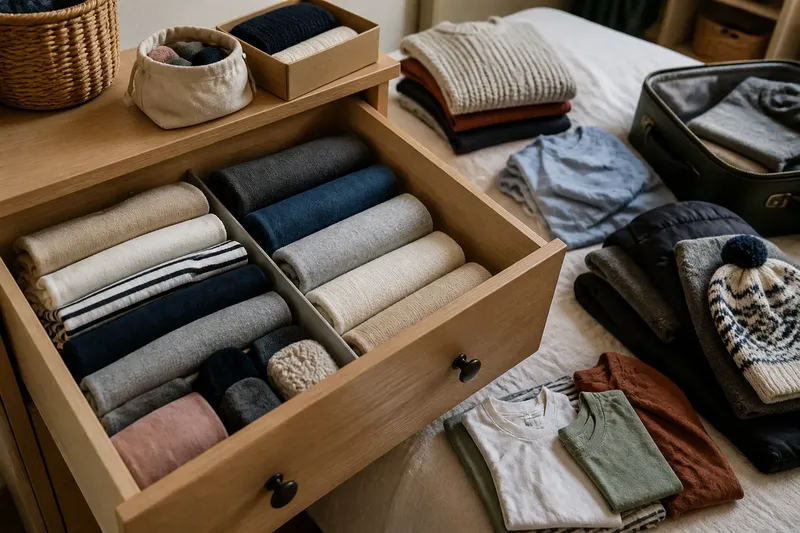
The common mistake in a seasonal drawer reset is emptying everything onto the bed before deciding what the drawer needs to do. That turns a small changeover into a pile that must be dealt with immediately, and it often ends with a hurried purchase of dividers. A seasonal drawer reset without buying organisers works better when you choose the scale of the job first, then use the drawer’s contents and whatever is already at home.
There are three sensible approaches: a light edit, a partial rotation, and a full reset. Each has a different cost in time and disruption. None requires every garment to be folded to matching dimensions; drawers are for getting dressed, not for passing inspection.
Which kind of reset fits your drawer?
Start by looking at the drawer as it is. Can you see the clothes you reach for? Is the incoming season’s clothing already stored elsewhere? Are there items that belong in another room or need laundering? These answers help determine whether the change is mostly about removing clutter, changing access, or moving a whole group of clothes.
- Light edit: remove items that are clearly out of use, then group the remaining clothes by type. Choose this when the drawer is usable and the season change affects only a few pieces.
- Partial rotation: move the most seasonal clothes in or out while keeping everyday basics in place. Choose this when temperatures are changing gradually or you still wear garments from both seasons.
- Full reset: take everything out, assess it, and reload the drawer around the coming season. Choose this when the drawer is hard to use, its contents have become mixed, or a substantial rotation is due.
Think of these options as adjusting a bookshelf: you can move one row, change the order of a shelf, or take the books down and arrange the whole thing anew. The useful choice is the smallest one that resolves the actual problem. A full reset is not automatically more thorough if it simply creates more laundry and more decisions.
What can a light edit achieve?
A light edit keeps the existing arrangement largely intact. Take out garments that are plainly dirty, damaged, or no longer useful in this drawer. Put laundry in its usual place, set aside any repair, and return the rest in a few broad groups such as socks, tops, and sleepwear. If an item belongs elsewhere, move it now rather than making a temporary pile.
This approach suits a drawer that is crowded at the edges but still easy to use. It also suits a household where the weather shifts unpredictably and storing away one season’s clothes would be premature. A thin layer of warm-weather basics, for example, may still earn its space when cool evenings are common.
The limit is that a light edit cannot create much room if the drawer is packed with clothing for a different season. It may improve visibility without changing what is accessible. If you keep pushing aside the same bulky garments to reach everyday items, consider a partial rotation rather than repeating the edit.
When is a partial rotation the better choice?
A partial rotation changes access without asking you to reorganise every item. Keep the clothes likely to be worn soon near the front or top. Move clearly out-of-season pieces to a clean, dry storage place already available, such as a suitcase, a spare shelf, or a suitable lidded box. Do not put clothes away damp or alongside items that could transfer dirt or odour.
Use existing containers as temporary boundaries, not as a reason to buy a matched set. A clean shoebox can hold socks; a small fabric bag can corral tights; an old pillowcase can keep a group of folded garments together on a shelf. Check that the container fits without pressing the drawer shut or making the contents awkward to retrieve. If you have nothing suitable, folded groups can sit side by side without a container.
This option suits a gradual transition and a drawer shared by more than one person, where changing every category at once may cause confusion. Agree on what is moving and where it will go. Keep the division obvious: the clothes for current use should be reachable without lifting the stored group out each morning.
What belongs in a full reset?
A full reset is useful when the drawer has lost its logic or the incoming season calls for a substantial change. Work on one drawer only. Clear a surface, remove the contents, and make simple groups: keep here, store elsewhere, laundry, repair, and undecided. The undecided group should stay small; it is a holding place for a real choice, not a second home for every garment you dislike deciding about.
Before returning anything, consider the drawer’s job. If it holds everyday tops, there is little benefit in giving prime space to formal clothing worn rarely. If several people use it, group by owner or garment type in the way they actually search. A layout that makes sense to the person who loads the laundry may not be the layout that helps the person getting dressed.
Put the most frequently used items where they are easiest to reach, then place occasional items behind or beneath them if the drawer allows. Leave some unoccupied space. It makes folded clothes easier to remove and gives the next seasonal change somewhere to go; a drawer packed to the edge has no room to absorb a new jumper or a late warm spell.
How do you decide what to store, keep, or pass on?
Use observable reasons rather than the vague instruction to “be ruthless”. Ask whether the item fits, is comfortable, is in wearable condition, and is likely to be used in the coming season. If it needs repair, decide whether you have a realistic plan to mend it. If it is clean and wearable but no longer wanted, identify a suitable reuse or donation route rather than leaving it in the drawer as a permanent pending decision.
Say you are changing a drawer that holds both light tops and thick winter layers. You notice that you reach for the tops most days, while several bulky layers are taking up the front. Move the clearly cold-weather pieces to a clean suitcase, keep one versatile layer within reach, and return the tops by type. The expected result is that daily clothes are easier to find while the transition remains reversible if the weather turns cool again.
Do not make an item’s future depend on an imagined occasion. If you keep it for a specific use, make that use concrete enough to remember. A garment reserved for a known event or work requirement has a clearer claim on space than one kept because it might someday be useful.
Which reset questions help settle the choice?
How much room should I leave in a clothing drawer?
Leave enough space to lift out a folded item without forcing the neighbouring clothes aside. There is no single correct fill level because drawers and garments differ; the practical test is whether the contents can be returned without pressing them down.
Can I use cardboard boxes as drawer dividers?
Clean, dry cardboard can separate small groups if it fits securely and has no rough edges that catch fabric. Use it only where it stays stable, and remove it if the drawer becomes difficult to open or clean.
Should I store clothes in the same drawer between seasons?
That depends on available space and how often the clothes remain useful. Keep transitional basics accessible, and move only the items that are unlikely to be worn soon; a complete swap can be inconvenient when the season changes unevenly.
What should I do with clothes that need repair?
Set them apart from wearable clothes and decide on a specific next action, such as placing them with a mending kit or arranging help from a tailor. If the repair is beyond your ability or concerns a safety-critical item, ask a qualified professional or follow the maker’s instructions.
How can the drawer stay usable after the change?
Once the clothes are back, check the drawer in ordinary use rather than rearranging it by appearance alone. If a group gets buried, move it closer to the front. If a container makes a small category harder to reach, remove it. The arrangement is doing its job when the clothes are easy to put away and easy to find.
Keep any stored seasonal group together and give it a clear, ordinary location. A note on a box can help in a shared cupboard, but there is no need to label every folded item. Avoid placing stored garments where damp, direct sunlight, or household spills are likely to reach them, and use suitable storage guidance for delicate fabrics.
For a seasonal drawer reset without buying organisers, choose the light edit when the drawer already works, a partial rotation when access needs to change, and a full reset when the arrangement has stopped serving its purpose. Then leave enough room for the next change. The most useful drawer is not the one with the neatest boundaries; it is the one that still works on a rushed morning.