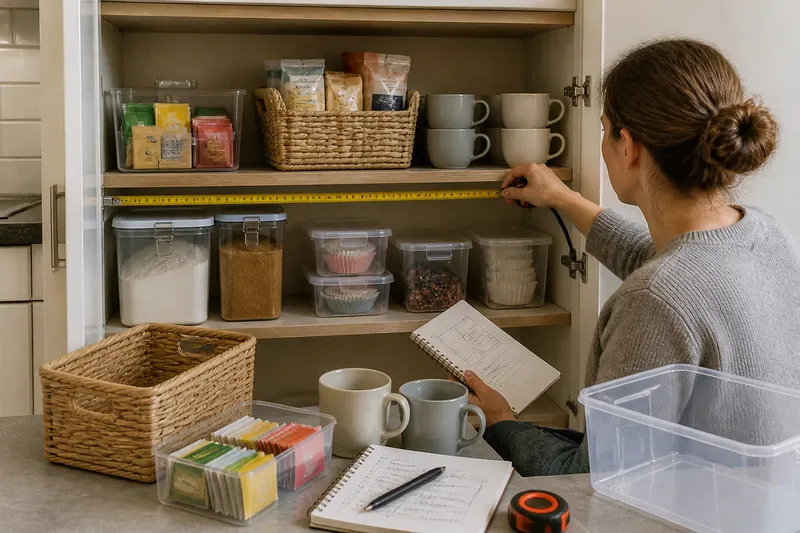
The Lid, the Rim and the Seal: Why Container Shapes Matter
Container shape affects access, stacking and containment. Learn how lid openings, rims and closures suit dry goods, leftovers, tools and shared storage.
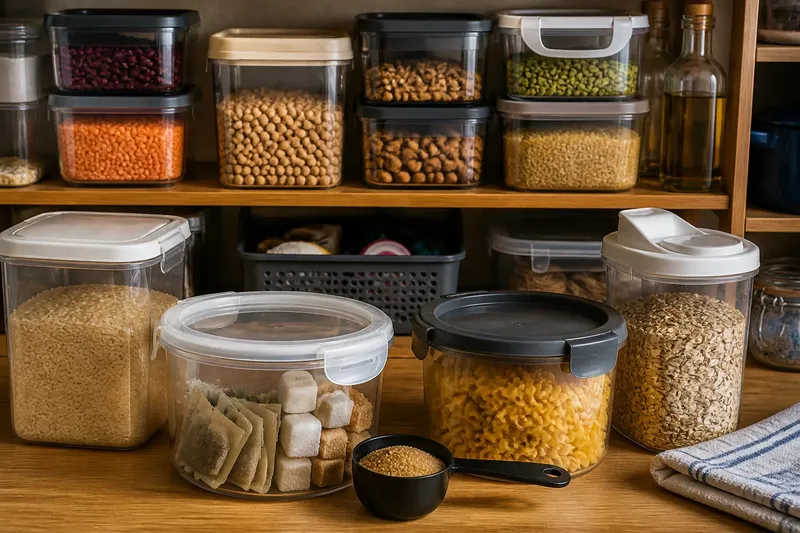
The common mistake with container shape is choosing by capacity alone: the box holds the thing, so it seems suitable. Then a broad scoop will not fit through the opening, the lid catches on a shelf, or a container of small parts leaks through an unhelpful gap. For ordinary storage, the lid, rim and seal often matter more than the outline of the body.
Container shape is best judged by the route contents take in and out, the way the lid meets the rim, and what happens when containers sit together. These seven checks help match a shape to a task without treating every cupboard as a showroom.
1. How wide should the opening be?
Compare the opening with the largest object or tool that must pass through it, not with the container’s outside width. A narrow neck can make a tall jar look capacious while leaving little room for a hand, scoop or folded cloth. A wide opening is easier to load and clean, but it also leaves a larger mouth to cover and may take up more room in a tightly arranged cupboard.
For dry ingredients, consider the utensil that will retrieve them. A measuring cup needs room to enter and turn; a small spoon can work in a narrower jar. For objects such as cables or craft supplies, access may matter more than a perfectly close fit. The right shape is the one that lets you remove the contents without tipping out the rest.
Check the opening at its narrowest point. Some containers flare at the top but taper below the rim, which can make a bag of contents catch as it is poured in. A straight-sided mouth is usually simpler to fill and wipe. If the contents are awkwardly shaped, bring a representative item when comparing containers, rather than relying on the product silhouette.
2. What does the rim do?
The rim is the meeting surface between body and lid. Its profile can guide a lid into place, provide a ledge for a clip, or leave a channel where crumbs and liquid collect. A deep groove may help locate a fitted lid, yet it is more fiddly to clean than a smooth, uncomplicated edge. Look at both sides of the joint: a tidy lid can still leave a troublesome recess on the container.
Rounded rims can feel comfortable to handle and may be easier to wipe. A projecting lip can make a lid easier to lift, but that projection may obstruct a close row of containers or catch on a shelf. Neither shape is automatically better. Ask what the rim needs to do in the actual storage location: guide closure, provide grip, or stay out of the way.
Where containers are used by several people, a visible lid edge can make it clearer how the closure sits. A lid that appears flush but is slightly displaced invites another person to assume it is shut. A simple, distinct seating surface is often more useful than a complicated rim with several small channels.
3. Does the closure match the contents?
A lid can rest on a rim, snap over it, screw into a neck, or clamp against a gasket. These forms make different compromises. A resting lid is quick to lift but may shift if the container is moved. A snap lid can hold its position more firmly, though its tabs need room to operate and may be awkward to press if the container is stored against a wall. A screw lid takes an extra turn but can be convenient on a narrow opening.
A gasket is a compressible ring intended to close the joint. It needs an even contact surface and can add a groove that collects residue. A closure without a gasket may suit dust protection or routine cupboard storage, while a gasketed lid may be preferable when the contents must be better contained. A lid’s appearance alone does not establish that a container is leakproof or suitable for a particular food; check the maker’s description and care instructions for that use.
Think about how the lid will be handled, too. If a container is opened several times during a task, a closure that is secure but slow to release can become irritating. If it will be carried, closure engagement matters more than quick access. A lid should be judged in the context of the movement it must withstand, not merely by how neatly it rests on an empty container.
4. Will the shape stack without wasting access?
Flat lids and straight walls can make stacking straightforward, but only if the lid is designed to bear another container and the base sits securely on it. A domed lid may protect contents or provide extra headroom, yet it can reduce the stable surface available above. If several shapes are stacked, small differences in footprint can make a neat pile feel like a precarious arrangement of saucers.
Look for a base that locates on the lid rather than sliding freely across it. A shallow ridge or recessed landing can help alignment, while a pronounced rim may make the upper container wobble. Also check whether the stack can be reached in order: a container used every day should not be trapped beneath rarely used supplies simply because its lid happens to be flat.
For a shelf, compare the container’s full height, including the lid and any clips, with the available opening. A box that fits only when its clips are pushed sideways is not an especially useful fit. Think of stacking like putting a lid on a saucepan: the outline may match, but a handle or raised knob still decides whether the arrangement works.
5. What shape makes pouring and cleaning easier?
A pouring lip can direct dry goods or liquids towards a target, but it can also create a corner where residue remains. A wide, smooth opening is easy to reach with a cloth or brush. Narrow necks are harder to inspect and may need a bottle brush, while square corners can collect crumbs if the internal edges are abrupt. Consider the cleaning tool available in the household rather than assuming every container can be wiped by hand.
Internal shape matters as much as the outside. A rounded base can help a spoon reach the last of a soft or granular content. A flat bottom may stand more reliably, but a sharp internal corner can be awkward to clear. For items that are not washed between uses, such as spare buttons or screws, cleanability may be a lesser concern than access and containment.
Say you need to store loose tea bags and a scoop of sugar beside a kettle. A hypothetical container with a broad mouth, a smooth interior and a lid that lifts without moving neighbouring items would let you reach both contents cleanly; a narrow-necked jar might hold the same amount but make the scoop a nuisance. The observable difference is in daily handling, not in the label on the shelf.
6. Which shapes suit particular storage tasks?
Match the geometry to what goes in, how often it comes out, and where the container lives. These are useful starting points, not fixed rules:
- Dry pantry staples: A broad opening helps with scooping and wiping. Choose a closure that limits routine spills and is straightforward to close after repeated access.
- Small hardware: A shallow, wide container makes pieces visible and reachable. A secure lid matters if it will be carried or moved between work areas.
- Leftovers: A low, broad shape can make contents easier to see and serve. Check that the lid closes evenly and that the container’s intended use matches the food and handling conditions.
- Cleaning cloths: A wide mouth avoids forcing folded fabric through a narrow neck. A simple lid is often easier to remove with one hand than a multi-part closure.
- Craft materials: A square or rectangular body can fit neatly into a shelf, while a rounded opening may still make odd-shaped pieces easier to retrieve. Prioritise the contents and their handling over a perfectly uniform set.
These choices need not lead to one container style for the whole room. A household may sensibly use broad tubs for frequent access, jars for small dry items and lidded trays for pieces that must remain visible. The useful comparison is between shapes serving the same task, not between every object on a shop shelf.
7. What should you ask before choosing a container?
How do I tell whether a lid closes securely?
Check how the lid engages with the rim and whether the closure has a clear, even seating position. A loose resting cover is suited to different handling from a clip or screw closure; do not infer a seal from a snug-looking fit alone.
Are square containers always easier to stack?
They can use shelf space neatly, but stackability depends on the relationship between the base and lid, not just the body outline. Check for a stable landing surface and whether lids or clips prevent containers sitting together.
Does a wider opening always make a container better?
It improves reach, filling and cleaning for many tasks, but it may need a larger lid and more clearance. A narrower mouth can be suitable when the contents pour cleanly and the container does not need frequent hand access.
Can any lidded container hold food?
No. Suitability depends on the material, intended use and care directions, not simply on whether a lid fits. Follow the manufacturer’s instructions, and ask a qualified professional if a specific food-safety concern cannot be resolved from the product information.
How do you choose for the task rather than the silhouette?
Start with the contents, then trace their ordinary route: how they enter, how they are removed, how the lid meets the rim and where the container will sit. Check opening width, interior corners, closure action, stack contact and the space needed to lift the lid. These details make container shape a practical decision rather than a preference for jars or boxes.
For container shape, the most useful choice is rarely the one with the most elaborate seal or the neatest matching outline. It is the form whose opening suits the hand or tool, whose rim is easy to use, and whose closure behaves appropriately where it will be stored. One small check before buying can save a household from owning a very attractive container that requires a very small spoon.