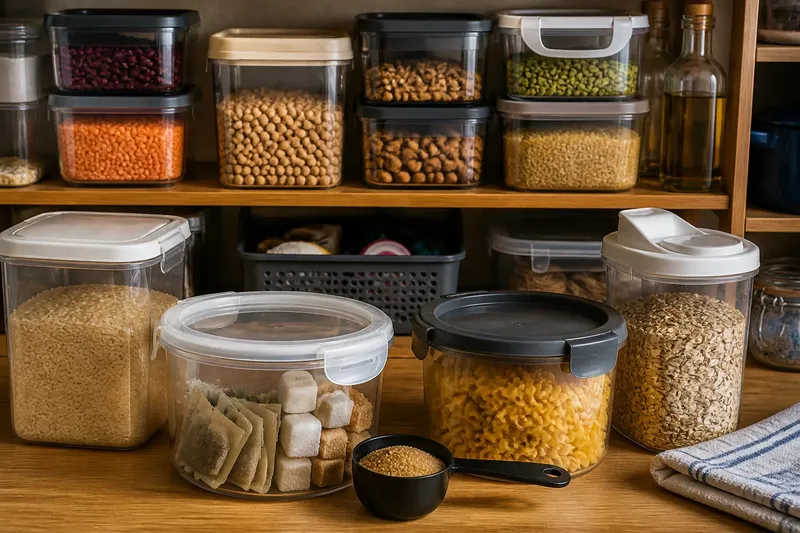
The Matching Container Trap
Matching containers can leave cupboard space stranded or hide what each holds. Choose varied storage sizes that suit the contents and make everyday items easier to spot.
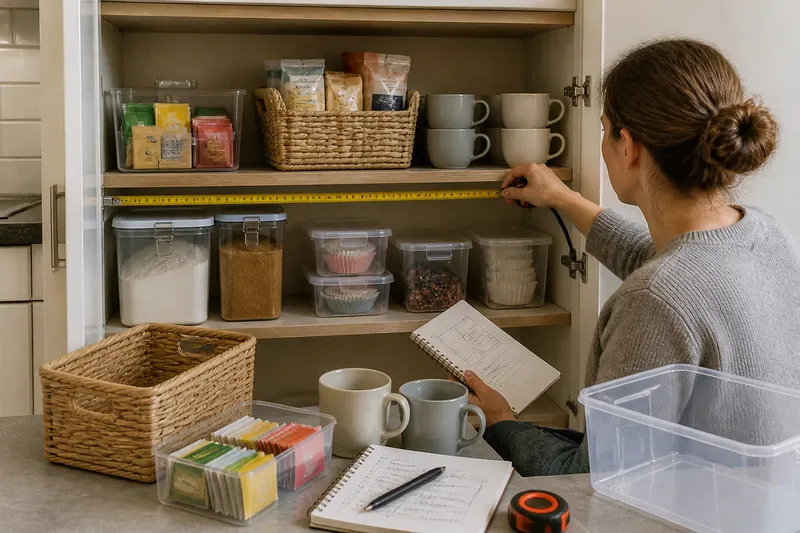
The common mistake with matching containers is buying a neat set before checking the cupboard. Identical boxes can leave awkward gaps, force unrelated contents together and make several indistinguishable lids look like a small administrative crisis. For cupboard storage, a mix of sizes is often easier to use because it follows the shape and frequency of the things you actually keep.
Do matching containers save cupboard space?
Not automatically. Uniform containers stack predictably, but a stack is useful only if its footprint fits the shelf and its contents can be reached without unloading half of it. A fixed-size box may be too large for tea bags and too small for packets of pasta; the unused space inside is no more useful than the gap beside it.
Matching dimensions can work well on a broad, regular shelf storing similar items. They are less helpful where the cupboard has a narrow side, a low shelf, a pipe, or a collection of objects with very different shapes. Space is saved by a good fit, not by visual agreement between boxes.
Think of containers like shoes in a hallway: a row of identical pairs looks tidy, but it does not make a boot fit into a slipper-sized space. Choose the shape for the job before choosing a uniform appearance.
Why do container dimensions matter more than a matching look?
Cabinet storage is a question of access and usable space, not whether the outside of each box matches. Before buying, consider which items must stand upright, which can be grouped in a tray, and which are already stable without a container. A tall packet may need height; loose clips may need a shallow dish; a stack of mugs may need neither.
Uniform boxes can encourage unlike things to share a space simply because they fit. A small torch, spare hooks and batteries may end up together under a broad label such as “bits”. The cupboard appears orderly while the search becomes slower. Grouping by use is usually more informative than grouping by container size.
Use clear sides where seeing the contents helps, and opaque boxes where light, visual clutter or privacy makes that less useful. A simple label should name the contents or the task they belong to, rather than describe the container. “Spare bulbs” is more useful than “small box”.
How should you choose different container sizes?
Start with what needs storing, not with a set. Note the largest items, the smallest loose pieces, and which things are used together. Then look at the cupboard’s shelf depth, height and usable width. A tape measure can help with the space, while a paper list or a quick sketch keeps the contents in view.
- Frequent access: Check whether an item is used often. If it is, place it in a container you can lift or reach without moving another; otherwise, a less accessible shelf may be suitable.
- Loose small items: Check whether pieces spread across the shelf. If they do, use a shallow tray; if they already stay together, leave them as they are.
- Upright packets or bottles: Check their shape and the shelf clearance. If they need to stand, choose a taller box that fits; otherwise, use a lower container or no container.
- Bulky objects: Check whether the objects genuinely belong together. If they do, choose a broad container; if not, separate them or leave them loose.
- Removal space: Check whether a box can be pulled out and returned without catching. If it cannot, choose a narrower option or store the contents directly on the shelf.
Say you have a narrow kitchen cupboard containing tea packets, spare mugs and baking supplies. You set the contents on the counter, measure the shelf with a tape measure, and find that the mugs already stack securely while the tea packets are short and the baking supplies include upright packets. You put the tea in a shallow tray, place the baking supplies in a taller basket, and return the mugs without a container. The resulting arrangement keeps tea together, lets the baking packets stand, and leaves the mugs easy to lift.
Should every item have its own container?
No. A container adds value when it keeps a group together, makes access easier or prevents loose items from spreading. It adds little when the items already sit securely, are easy to identify, or need to be taken out one by one. An empty shelf surface can be a more useful organiser than another plastic box.
For small loose objects, a compartmented tray may make sense if its divisions match how the objects are used. For bulky or irregular items, a flexible basket can be easier to load than a rigid box. If an object is used daily, leaving it visible and within reach may be better than enclosing it for tidiness.
Consider how the container will be handled, too. A full box that is awkward to lift is not an improvement merely because it fits the shelf. Keep heavier contents low and avoid stacking items in a way that makes ordinary access needlessly cumbersome.
What should you check before buying containers?
Check these details against the cupboard and its contents; each one should lead to a clear decision rather than a vague hope that the set will somehow fit.
- Shelf shape: Check for corners, supports and obstructions. If the shelf has a blocked or narrow area, choose a container that fits its accessible part; otherwise, a regular box may suit the open space.
- Contents: Check whether items are alike and used together. If they are not, separate them; if they are, a shared container may keep the group convenient.
- Access: Check whether the container can be pulled forward and returned easily. If not, choose a smaller or lighter option, or leave the items loose.
- Visibility: Check whether seeing the contents helps identify them. If it does, choose a transparent side or clear label; if not, an opaque container avoids needless visual detail.
- Future changes: Check whether the group is likely to grow, shrink or change. If it is, choose a flexible basket or open shelf area; if not, a fitted rigid box may be appropriate.
- Existing supplies: Check for boxes, trays or jars already available. If one suits the contents and shelf, reuse it; otherwise, look for a container that addresses the specific mismatch.
How can you tell whether a cupboard needs a mixed set?
A mixed set is a good candidate when the contents vary in size, the shelves have awkward dimensions, or you regularly move one group without needing the others. Matching pieces are still useful for repeated, similar items and for shelves where a stable stack is genuinely convenient. The point is not to reject uniformity; it is to avoid treating it as the goal.
Before buying, try the proposed arrangement with empty cartons or existing trays. Set them on the shelf, check that the contents can be reached, and notice whether unused spaces are large enough to be useful. This simple rehearsal can reveal that the cupboard needs one narrow tray and one generous basket, not a complete matching family.
Are matching containers ever the better choice?
When do identical boxes work well?
They suit repeated items of similar size and a shelf with regular dimensions. The common footprint can make stacking and grouping straightforward.
Can labels solve the problem of identical containers?
Labels help when the boxes are otherwise hard to distinguish and their contents stay reasonably stable. They cannot correct a poor fit or make unrelated contents easier to manage.
Is clear plastic always more useful?
No. Transparent sides help with contents that are hard to identify by name, while opaque containers can reduce visual clutter. Choose based on what you need to recognise, not on visibility as a rule.
What if the cupboard contents keep changing?
Use fewer rigid divisions and leave some adaptable space. A basket or open shelf can accommodate changing groups more readily than a set of boxes sized for a past arrangement.
For matching-container decisions, judge the cupboard by how easily you can put things away and find them again, not by whether every box resembles its neighbour. A varied arrangement can look less uniform and work considerably better; the cupboard has not been asked to attend a design review.