Open Shelves or Closed Boxes? A Comparison by What You Store
Compare open shelves or closed boxes by dust, access and visual calm, then choose a format for each shelf zone without turning a small change into a room project.
The common mistake with open shelves or closed boxes is treating them as competing room-wide systems. That can leave a shared shelf looking orderly to one person and inconvenient to everyone else. Compare the formats by the job each part of the shelf must do, then decide where an open surface or a closed boundary earns its keep.
What changes when a shelf is shared?
On a shared shelf, storage affects more than tidiness. One person may need a clear surface for sorting post; another may want the shelf to stay visually quiet. A decision based only on appearance can turn into an unspoken rule about who gets access and who has to move things.
Before changing the arrangement, identify the shelf’s shared purpose: a landing place for household paperwork, a supply point for a joint project, or simply somewhere to keep items that belong to several people. Agree which parts need to remain available and which may be put away. This is a small conversation, but generally cheaper than a second set of containers bought in protest.
Which format makes a shared routine easier?
Open shelves make it possible to see and reach contents without opening a container. That suits items several people need to locate independently, provided the objects can tolerate exposure and the visible arrangement does not crowd the shelf.
Closed boxes create a boundary around loose or visually busy belongings. They can also give a shared project a clear stopping point: tools and materials go back into one place when work pauses. The trade-off is that other people may not know what is there, or may need to ask before opening a box that feels personal.
Think of the choice like a shared kitchen drawer: leaving a utensil visible can make it easier for everyone to use, while keeping a specialist tool in a case helps prevent it becoming part of the general jumble. Neither format is inherently considerate; the arrangement has to match who uses the shelf and how.
How can you set boundaries without assigning the whole shelf?
Divide the shelf by use rather than by an abstract rule that everything must be open or everything must be hidden. A shallow tray can mark the shared supplies; a labelled box can hold one person’s materials; a clear section can remain free for temporary items.
Keep boundaries visible and easy to follow. A piece of removable tape at the edge of a zone, a tray with a distinct shape, or a short label such as “shared stationery” can clarify where things belong. Avoid labels that announce ownership in a way that sounds more territorial than useful.
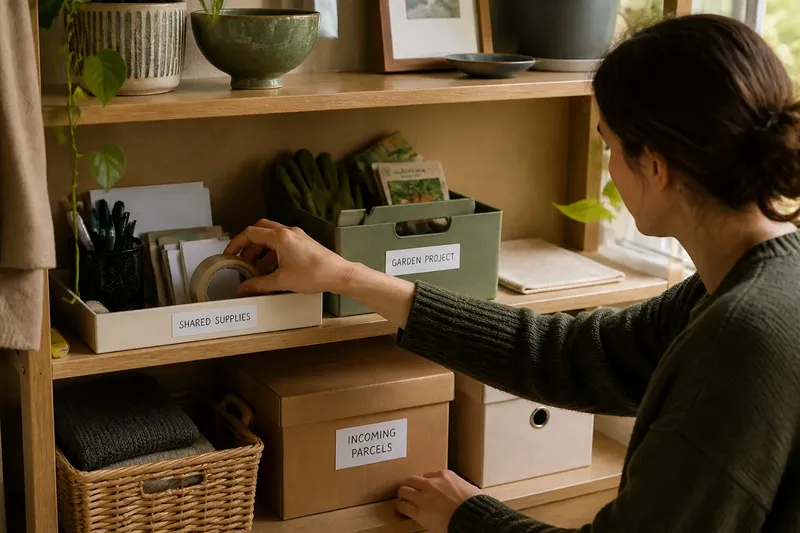
Say two housemates use a shelf for parcels and a community garden project. The starting point is a crowded open shelf, with seed packets, gloves, parcel tape and delivery notes mixed together. They agree to keep parcel tape and current delivery notes in an open tray, put the garden gloves and spare seed packets in one labelled box, and leave a clear patch for incoming parcels. The expected result is that each person can find the shared packing items at a glance, while the project supplies stay together; if someone needs a seed packet during a work session, the box can be moved to the shelf’s front rather than making the whole arrangement open.
What should you agree before changing the shelf?
- Check who uses the shelf. If several people need the same items, keep that group visible or easy to reach; if access is occasional, agree on a box or defined zone instead.
- Check whether items are personal or shared. If ownership is unclear, ask before relocating them; if they are shared, use a neutral container or label that describes their purpose.
- Check what must stay accessible. If someone needs an item during an ordinary routine, leave it in an open position or choose a box that is easy to reach; if not, closed storage may be reasonable.
- Check whether the visible area has a shared purpose. If it must hold parcels, paperwork or current project materials, reserve that space; if no one relies on it, consider using it for a contained group.
- Check whether the proposed label is clear to everyone. If it names a shared activity, keep it; if it relies on one person’s private shorthand, replace it with plain wording or a transparent container.
- Check what happens when the shelf is full. If new items have no agreed place, remove or relocate something with the group’s consent; if the items are all still needed, revise the zone boundaries before adding another box.
What do people ask about shared shelf storage?
Should a shared shelf use matching boxes?
Matching boxes can make a shelf look consistent, but consistency does not tell people where shared items belong. Use them only if their contents are easy for everyone to identify, through clear fronts, plain labels or an agreed arrangement.
How do you keep personal items separate?
Give personal belongings a defined container or section and ask before moving them. If the shelf is too small for a separate zone, agree on another location rather than quietly treating someone else’s items as surplus.
Is open storage fairer for shared supplies?
It can make shared supplies easier to find, but it also leaves them exposed and visible. Choose an open tray for items people use often; use a box if containment matters more, while making its purpose clear to everyone.
What if people disagree about the arrangement?
Start with the routine causing the disagreement and change only the affected section. If one person needs visibility and another wants a clear shelf, a small open tray beside a closed box may meet both needs without imposing one format on every item.
How do you know whether the arrangement is working?
Pay attention to ordinary use rather than judging the shelf only after tidying it. If people put shared items back in the agreed zone and can retrieve them without asking, the boundary is doing its job. If objects repeatedly migrate or a box is avoided, revisit that specific zone with the people who use it.
Open shelves or closed boxes work best in a shared space when the arrangement makes access and ownership legible. Keep the agreement modest: one clear boundary and a place for items that do not fit are more useful than a shelf plan everyone forgets by the next busy afternoon.